
The National Agricultural Research Institute is making an entry into farm mechanisation to improve the way sago is processed in the country.
Sago is a staple food for many coastal communities and involves a very tedious process from felling of mature palms to the separation of starch from the fibre.
To reduce this labour-intensive process of sago starch extraction, NARI through it’s Farm Mechanisation Division intends to evaluate the use of a Brush Cutter as a prototype through a project called the: “Performance Evaluation of Modified Brush Cutter-Based Rasping Machine for Small-Scale Sago Starch Extraction in Papua New Guinea”.
The project set to commence in the first quarter of 2027 received a funding support of One-Hundred-Thousand-Kina (K100,000) from the PNG Science and Technology Council Secretariat (PNGSTCS).
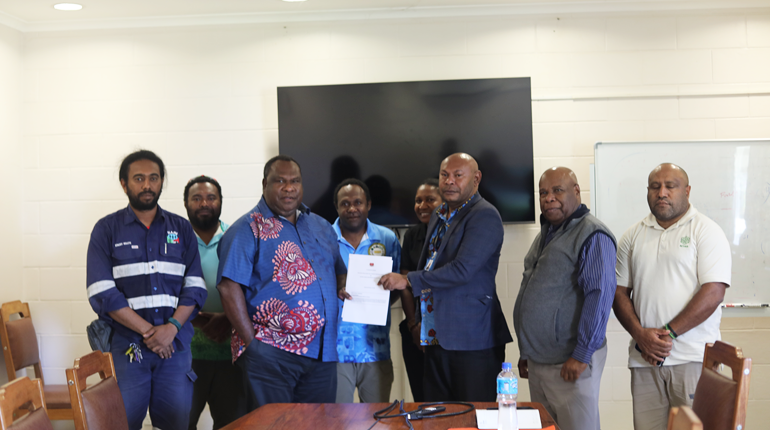
Formalities sealing the agreement took place at the NARI headquarters in Lae on November 5 between Director General Dr. Nelson Simbiken and PNGSTCS Acting Director – Grants, Mr. Jordan Dean.
After the signing of the agreement, Mr. Dean elaborated that PNGSTCS has shifted its focus into projects that involve applied research in science that can identify practical and sustainable solutions through positive contribution towards the country’s economic development.
Dr Simbiken expressed his gratitude to PNGSTCS adding that the process involved in producing sago requires mechanical and electrical specialists who can develop and improve the existing innovation by sago farmers. He says without good research and data, commercialisation and sustainability in agriculture will not be achieved.
“The process involved in sago processing includes sedimentation and this process must be automated. Such initiatives will transform the way we do farming in a more cost-effective manner,” expressed Dr Simbiken.
The project will be implemented by the Farm Mechanisation Division at NARI’s MOMASE Regional Centre at Bubia in Lae, Morobe Province.
NARI’s Principal Scientist and Project Team Leader, Dr. Caleb Breria says the project aims to assess the efficiency of the brush cutter-based rasping machine, and how it will become a sustainable tool for sago-eating communities after the project ends.
“The sustainability of this sago extraction technique will rely on the sago-eating communities. Over 50 percent of provinces rely on sago as a staple food, which plays a very important role in food security. NARI’s role is to help in refining the sago extraction process through the use of sago rasping technology,” stated Dr. Breria.
The project will commence in the first quarter of 2027 with pilot communities in Morobe, East and West Sepik, with possible intention to cover Manus, New Ireland, Gulf and Western provinces. Baseline data from these pilot sites will help the team to assess and collect data on the efficiency and starch recovery rate of the sago-rasping prototype to fully determine proper modification and design of the tool.
Data will also be collected on the starch recovery rate with the use of the Sago Rasping Prototype in comparison with the manual method of extracting sago starch.
Studies dated back to 1995 and as recent as 2007 by renown Dutch Agronomist D.L.Schuiling indicated that traditional extraction systems leave behind a substantial amount of starch resulting in considerable productivity losses while this project is aimed at assessing how starch can be recovered through the use of the sago-rasping machine in an efficient and sustainable manner.
Apart from the efficiency study of this prototype, the team also aims to assemble designs and modeled prototypes for replication by sago farmers.
NARI is grateful to the PNG Science and Technology Council Secretariat for the funding support for the project which will take 12 months to complete.