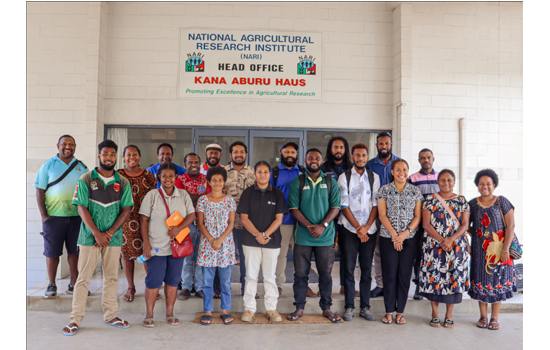

Seven students who are studying Bachelor of Agriculture Science at the PNG University of Technology have shown great interest in research following their six weeks of Industrial Training with the National Agricultural Research Institute.
As part of their Third (3) Year assessment, five of the students were attached with the Momase Regional Centre’s Livestock, Crop and Biotechnology Laboratory, at Bubia, Morobe Province and two at the Highlands Regional Centre, at Aiyura, Eastern Highlands Province.
The students in Lae, included, Mr Bradley Kenatsi, Mr Peter Nanau, Mr Victor Omot, Miss Lynette Tina and Miss Georgina Roy, while the students in Aiyura, were Miss Mischelle Algua and Mr Tilda Krane Gigil.
Projects assigned to the students include Rice post-harvest processing, Poultry hatchery operation and brooder management, Black soldier fly farming and operations, Disease detection and identification for sweet potato and taro, and the Effect of liquid and solid media targeting mass propagation of local (Numkowe) and NARI Taro (NT06) varieties.
The students were supervised by NARI Researchers, Ms Janiella Aidaboe, Ms Lucinda Gam, Ms Charlotte Okawiong, Mr Martin Raulera and Mr Edwin Wavite.
In Aiyura the students were engaged in producing planting materials using the mini sett technique on yam, cassava and nodal cutting on sweet potato, with additional skills in Screenhouse management, designing and marking out field plots, preparing soil samples, and strengthening other practical skills.
Assessing the germination of wheat seeds was the highlight of their six weeks of industrial training which mainly involved data collection, analysis, and interpretation.
Among the students, Mr Victor Omot and Ms Georgina Roy shared their experiences and wished they had more time.
Omot who plans to be an Agriculture Researcher was attached with Black Soldier Fly Farming and Operations.
“I have learnt a lot especially with the livestock section, mainly Black Soldier Fly, aquaculture, and other animal husbandry practices. My vision is to help others and improve in the way we practice farming in the near future,” expressed Mr Omot.
Ms Roy’s field time and data analysis on disease detection in sweet potato and taro, convinced her to pursue research in the future.
“Agriculture is evolving through research mainly in crop diseases and how to find ways to address them. There is a lot that can be done to improve the way we practice farming. It was good getting feedback from Papua New Guinean scientists who encouraged us to continue pursuing agriculture science,” expressed Ms Roy.
The students concluded their training earlier this month, with a final PowerPoint presentation before NARI Scientists and their supervisors.
NARI’s Principal Scientist (Breeding, Genomics & Biotechnology), Dr Caleb Breria encouraged the students to grasp the scientific research aspect of agriculture and the importance of data collection, analysis, and reporting.
NARI wishes the students well in their final year of study.